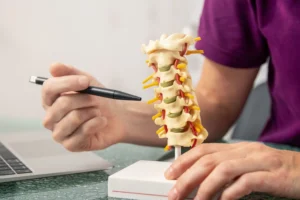
A bulging or herniated disc on an MRI does not automatically mean you need surgery, and it does not always explain your pain either. Imaging shows structure, not suffering, and plenty of people walk around with disc findings and no symptoms at all. For herniated disc treatment in NJ, Dr. Sojitra at Princeton Spine Disc and Chiropractic starts by separating what the scan shows from what is actually driving your pain. That distinction changes how the whole problem gets treated.
Myth 1: A disc on your MRI is the reason you hurt
It sounds obvious. Your back hurts, the scan shows a bulging disc, so the disc must be the culprit. But research on people with no back pain at all has repeatedly found disc bulges and even herniations on their imaging.
In other words, disc changes are common, and they do not always cause symptoms. That is why treating the picture instead of the patient can lead people down the wrong path. A finding on a scan is a clue, not a verdict.
What matters is whether that specific disc lines up with your specific symptoms, which takes an actual clinical exam to sort out, not just a radiology report.
Myth 2: A bulging disc always needs surgery
This is the big one, and it causes a lot of unnecessary fear. Many disc problems respond well to non-surgical care, and a large share of herniations even reduce on their own over time as the body reabsorbs the material.
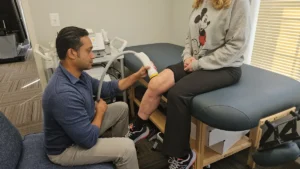
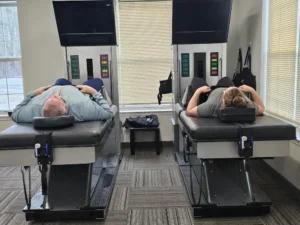
Dr. Sojitra is living proof of the non-surgical path. He recovered from an 11.5mm L5-S1 herniation, severe enough that he temporarily could not dress himself or lift his young daughter, without an operation. Using spinal decompression and chiropractic care, his own imaging documented it shrinking to roughly 3.5mm over time.
His full recovery story is on the Meet Dr. Sojitra page. Surgery is sometimes the right answer, but “always” is simply not accurate.
Myth 3: A bigger herniation means worse pain
You might assume the size of a herniation predicts how much it hurts. It often does not.
Some people with small bulges have significant pain, while others with large herniations have surprisingly little. Pain depends on factors like whether the disc is pressing on a nerve, how inflamed the area is, and how your nervous system is responding, not just the millimeters on a scan.
This is exactly why Dr. Sojitra evaluates the whole picture before recommending anything. The number on the report is one input among many, not the deciding factor.
Myth 4: If it’s structural, exercise can’t help
People sometimes hear “disc problem” and assume movement is off the table. The opposite is usually closer to the truth.
The right movement, guided appropriately, supports healing and takes pressure off irritated tissue. The catch is that “the right movement” depends on your specific situation, which is why generic stretches from the internet sometimes make things worse. Care here is built around what your evaluation shows, not a one-size template.
When a disc really does need medical attention
Busting myths does not mean dismissing every disc as harmless. Some situations are genuine emergencies, and knowing them protects you.
Seek prompt medical care if you experience loss of bowel or bladder control, progressive or sudden weakness in a leg, foot drop, or numbness in the saddle region. These red flags can point to serious nerve compression that needs urgent evaluation. Dr. Sojitra screens for them and refers out immediately when they appear, because that is what responsible care looks like.
What to do instead of panicking about your scan
If a report has you worried, the most useful next step is a clinical evaluation that connects the imaging to your actual symptoms. Dr. Sojitra’s evaluation-first process is built for exactly that, dedicating the first visit to understanding your case before any plan is offered.
From there, non-surgical options like decompression, adjustments, and supporting therapies can be matched to what is truly driving your pain. For many people in Skillman and the greater Princeton area, that is the difference between years of fear and a clear path forward.
Common questions about disc findings
Can a herniated disc heal without surgery?
Often, yes. Many herniations improve with non-surgical care, and some reduce on their own over time. Whether that applies to you depends on your specific case.
Should I get an MRI for my back pain?
Sometimes imaging is helpful, but it is not always necessary, and a scan alone rarely tells the whole story. A clinical evaluation determines whether imaging will actually change your plan.
Worried about what your scan means? Contact Princeton Spine Disc and Chiropractic or call (609) 228-9996 for an evaluation that looks at you, not just the picture.