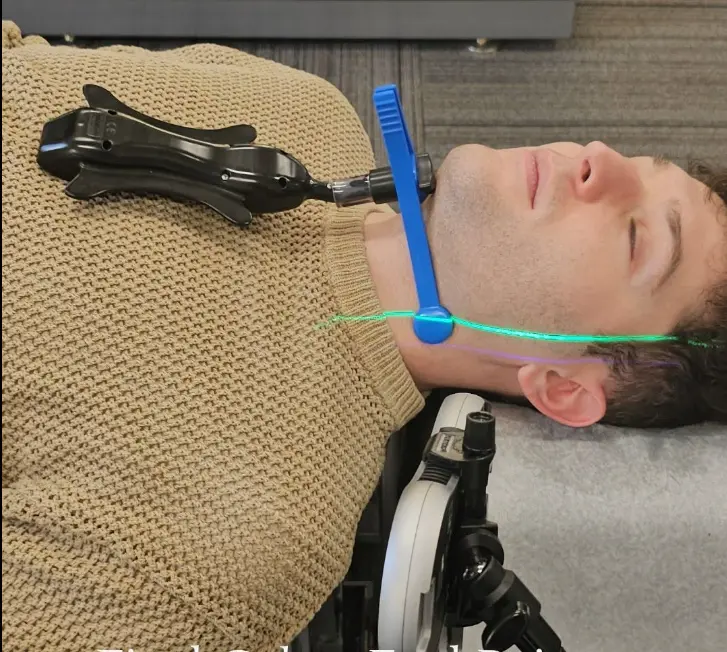
TMJ treatment often falls short because it focuses only on the jaw, when the real drivers can sit far away in the neck, the cranial bones, and even the pelvis. The jaw joint is connected through the spine and the membranes surrounding the nervous system, so tension in the pelvis can genuinely affect how the jaw moves. At Princeton Spine Disc and Chiropractic, serving Princeton, NJ, Dr. Sojitra treats TMJ as a whole-body problem, addressing the jaw, cranium, cervical spine, and pelvis together rather than the jaw alone.
Why Most TMJ Treatment Falls Short
Most people with jaw pain get sent down the same path: a night guard, some anti-inflammatories, and advice to avoid chewy foods. Sometimes that helps. Often it just manages the symptom while the jaw keeps clicking, aching, and locking.
The reason is that TMJ is treated as a local jaw problem when it frequently is not. If the jaw is being pulled out of balance by something elsewhere in the body, working only on the jaw will keep coming up short.
What Is TMJ Dysfunction?
The temporomandibular joint, or TMJ, is the hinge connecting your jaw to your skull. When it is not moving smoothly, you can get jaw pain, clicking or popping, headaches, ear symptoms, and difficulty opening the mouth fully.
What does your jaw feel like when you first wake up? For a lot of TMJ patients, the answer is tight, tender, or already aching, which is a clue that something is loading that joint even during sleep.
The Jaw-Pelvis Connection Explained
This is the part most patients have never heard. Your jaw and your pelvis are linked through the spine and through the meninges, the connective tissue membranes that wrap the brain and spinal cord and run from the skull all the way down to the sacrum.
Because that membrane system connects both ends, tension at the pelvis can transmit upward and influence how the cranial bones and jaw sit. It sounds surprising, but it explains why some jaws simply will not stay balanced no matter how much work goes into the jaw itself.
This is not a fringe idea, either. The membrane and structural links between the top and bottom of the spine are well described, and the Sacro-Occipital Technique used here was built specifically around those relationships.
How Dr. Sojitra Approaches TMJ in Princeton, NJ
Instead of treating one joint, the approach addresses the whole chain that influences it. That usually means working across several areas in the same plan.
The Jaw and Cranium
Cranial Facial Release is used to mobilize the cranial bones and sutures that affect jaw position. Dr. Sojitra is the only Elite Level 3 certified provider of this technique in New Jersey. If it is new to you, this overview of what Cranial Facial Release is explains how it works.
The Cervical Spine
The upper neck and the jaw share a close relationship, so chiropractic care focused on the cervical spine is often part of the plan. Restrictions in the neck can throw off jaw mechanics and feed the whole pattern.
It works the other way too. A jaw that is chronically tight and pulling to one side can keep the upper neck irritated, which is part of why jaw and neck problems so often show up together.
The Pelvis
Using SOT, or Sacro-Occipital Technique, pelvic blocks, Dr. Sojitra addresses the pelvis and sacrum to release tension at the bottom of that membrane system. This is the piece almost every other TMJ approach leaves out entirely.
A Demonstration You Can Feel
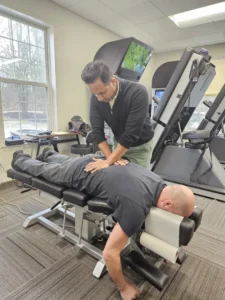
One of the more memorable parts of a TMJ evaluation here is watching the connection happen in real time. Dr. Sojitra can often demonstrate how adjusting the pelvis changes what the jaw is able to do, right there on the table.
It is one thing to be told the jaw and pelvis are connected. It is another to feel your jaw move more freely after work that had nothing to do with your jaw. That moment tends to make the whole-body approach click for people.
It also reframes what treatment should target. If the jaw responds to work at the pelvis, then a plan built only around the jaw was always going to leave something on the table. The demonstration is really a preview of why the broader approach is used.
How TMJ, Headaches, and the Neck Overlap
TMJ rarely travels alone. Because the jaw, upper neck, and cranial structures all share close quarters, jaw dysfunction often comes bundled with headaches, ear fullness, and neck tension.
That overlap is part of why treating the jaw by itself can disappoint. When the same underlying pattern is feeding several symptoms at once, addressing only one of them leaves the others in place. Looking at the whole system gives more of those symptoms a chance to settle together.
What Might Be Driving Your TMJ
TMJ dysfunction rarely has a single cause. Common contributors include:
- Restriction in the cranial sutures
- Cervical spine dysfunction in the upper neck
- Pelvic and sacral tension transmitted through the meninges
- Chronic clenching or grinding
- Old dental work or a past jaw or head injury
Sorting out which of these apply to you is exactly what the first-visit evaluation is designed to do.
What to Expect at Your TMJ Evaluation
New patients go through a two-day process. The first visit is a full evaluation with no treatment, looking at the jaw, the upper neck, the cranial bones, and the pelvis to map how they are interacting. The second visit is when Dr. Sojitra explains what he found and outlines a plan.
That order matters for a joint as connected as the jaw. Rushing into treatment before understanding the whole chain is how TMJ care so often ends up chasing the wrong link.
Frequently Asked Questions
Can a chiropractor really help TMJ?
When the jaw is being influenced by the neck, cranium, or pelvis, addressing those areas can help the jaw function better. It is a different approach from treating the jaw in isolation, and it fits cases where jaw-only care has not worked.
Do I have to stop seeing my dentist?
Not at all. This care works alongside dental treatment, and a night guard from your dentist can absolutely stay part of the picture. The two approaches address different pieces.
How long until my jaw feels better?
That varies with how long the pattern has been in place and what is driving it. Your evaluation will give you a realistic sense of what to expect rather than a one-size promise.
Is TMJ treatment here painful?
The techniques used are gentle, including the cranial and pelvic work. Most patients find the sessions comfortable, and many notice the jaw feeling looser fairly early, though how quickly things change varies from person to person.
Get to the Real Source of Your Jaw Pain
If jaw-only treatment has not solved your TMJ, it may be time to look at the whole picture. Call the practice at (609) 228-9996 or reach out through our contact page to schedule an evaluation in Princeton, NJ.