Herniated and Bulging Disc Treatment in Skillman NJ

Disc pain is Dr. Sojitra’s clinical home.  It’s literally in the name of this practice, and the DRX9000 decompression system was one of the first tools he invested in after experiencing disc herniation himself.

Understanding Disc Pain in Skillman NJ

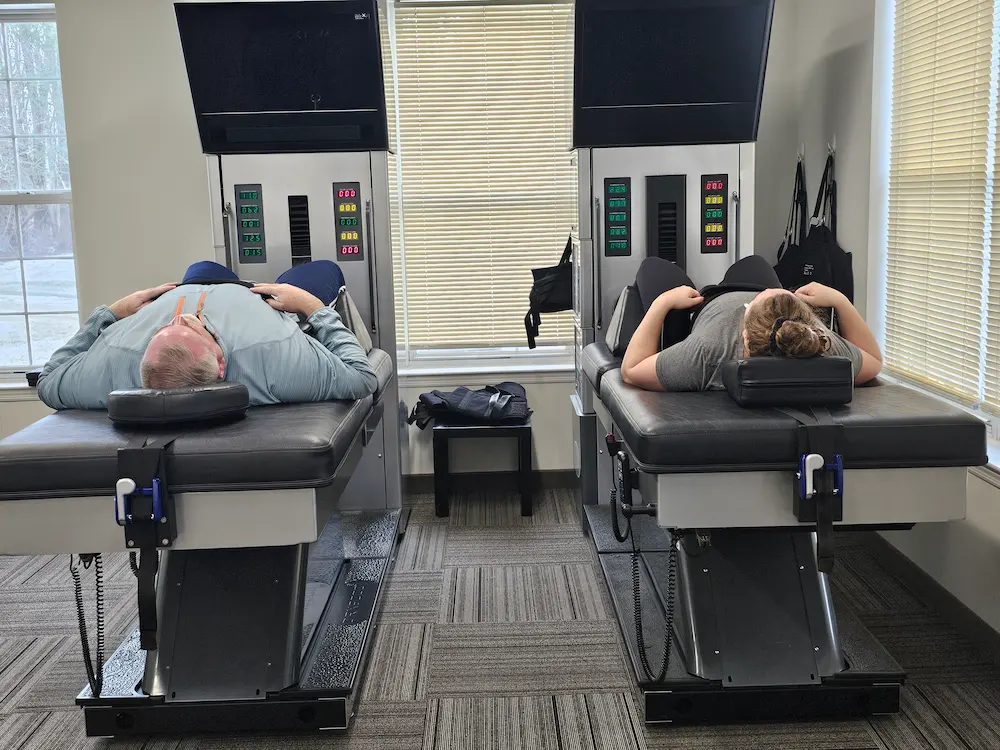
A man and a woman lie face up on separate spinal decompression tables in a therapy room.

Disc patients describe a deep, unrelenting ache in the lower back combined with a sharp electric sensation shooting down the leg. Numbness that wakes them at 3am. Coughing or sneezing that sends a wave of pain that takes their breath away. If that sounds familiar, you’re almost certainly dealing with a disc problem.

Spinal discs are the shock absorbers between vertebrae. A bulging disc can press on nearby nerve roots; a herniation tears the outer wall, allowing inner gel to push through and create more intense compression and inflammation. Both conditions send pain far from the disc itself, down the leg, into the foot, or into the arm, because the compressed nerve carries the signal wherever it travels.

The bulge vs. herniation distinction matters less than which disc is involved, which nerve roots are compressed, how severe the compression is, and what’s driving the mechanical load that caused the disc to fail. Dr. Sojitra’s evaluation answers all four questions before recommending anything.

White outline icon of a human torso from the back, highlighting the spine with individual vertebrae.

Deep, aching low back or neck pain that doesn't resolve with rest

Icon of a human leg with radiating lines around the knee, indicating pain.

Pain that radiates into the leg (lumbar discs) or arm and hand (cervical discs)

White outline icon of a human leg and foot with wavy lines on a black background.

Numbness or tingling in the leg, foot, hand, or fingers

A white outline icon of a flexed bicep muscle with two downward arrows above it, on a black background.

Muscle weakness in the affected limb, difficulty lifting the foot, gripping, or controlling movement

A pixelated icon of a person sitting at a desk with a laptop.

Pain that significantly worsens with sitting, bending forward, coughing, or sneezing

Why Disc Problems Develop

Disc injuries almost never happen in a single moment they are the result of gradual wear combined with a triggering event. The Princeton and Skillman area draws a significant population of desk-based professionals, commuters, and active adults, and the daily demands of those lifestyles create exactly the conditions disc problems develop from.
Dr. Sojitra’s own disc herniation developed this way no single injury, no obvious cause. He was healthy, active, working out regularly. He woke up one morning and could not move. The disc had been accumulating stress for years before it gave out. That experience shaped how he evaluates every disc patient who comes through his office.

01

Age-related disc dehydration discs lose water content over time, becoming less flexible and more susceptible to tearing under load

02

Prolonged sitting with poor posture, particularly the forward lean of desk work and long commutes that increases lumbar disc pressure significantly

03

Repetitive bending, twisting, or heavy lifting that accumulates stress on specific disc levels faster than the tissue can repair

04

A car accident, fall, or sports impact that put sudden compressive or rotational force through the spine often creating damage that is not immediately felt but becomes symptomatic months or years later

05

Years of compensating for an old injury that altered how load is distributed through the spine, stressing a disc that was never designed to carry that pattern

06

Weak core musculature that transfers load from the muscles where it belongs onto the discs and joints, which were not designed to absorb it alone

Dr. Sojitra's Approach to Disc Pain in Skillman NJ

Disc pain is the clinical specialty this practice was built around. Dr. Sojitra recovered from an 11.5mm herniation more than double the most severe case he’d seen in five years of practice without surgery, using the same tools he applies to his patients today. Care plans for disc conditions layer structural, mechanical, and cellular treatment simultaneously.

Zone Technique Chiropractic Adjustments

Zone Technique analysis identifies which neurological systems are under stress, directing adjustments to restore joint motion at the affected levels, reduce mechanical stress on the disc, and address pelvic and sacral alignment. For acute presentations, ArthroStim instrument adjusting or light touch technique provides effective correction without counterproductive force. Learn more about chiropractic care and Zone Technique.

DRX9000 Spinal Decompression

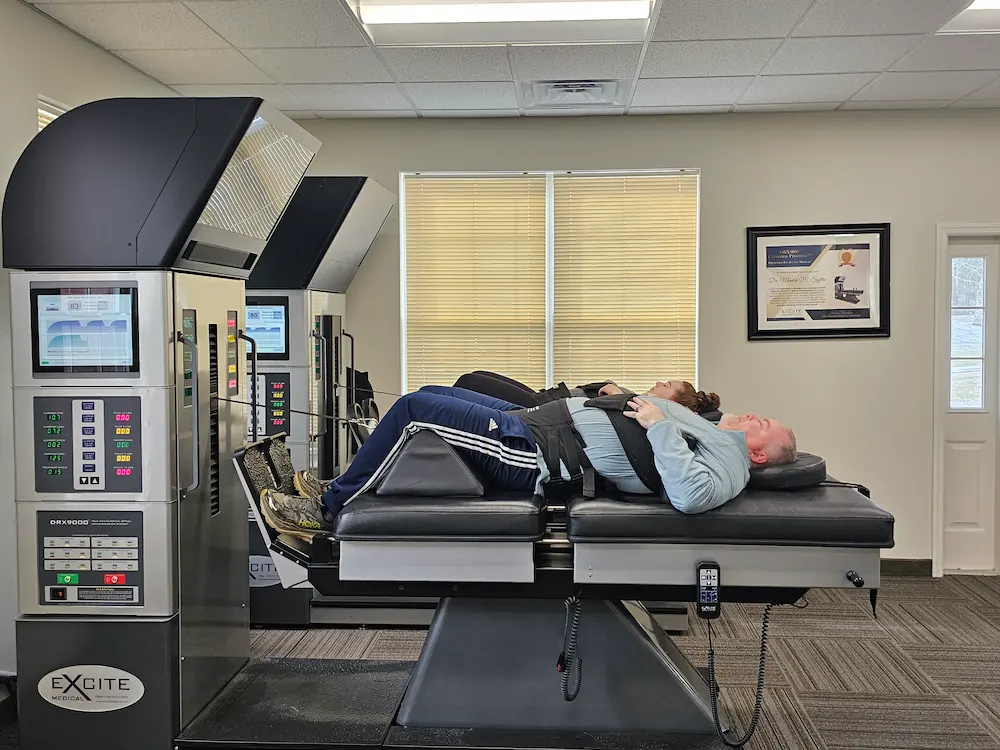
The DRX9000 is the primary tool for disc conditions here and the one Dr. Sojitra used in his own recovery. It creates computer-controlled negative pressure at the specific disc level, reducing intradiscal pressure, allowing herniated material to retract, and restoring the fluid exchange discs need to heal. For cervical disc conditions with radiating arm symptoms, the Chattanooga Triton DTS provides the same precision for the neck. Learn more about spinal decompression.

Cold Laser Therapy

The inflammation around a compressed nerve root produces the burning, shooting sensation disc patients describe. Cold laser therapy using the Euchronia GVL and Avant systems reduces that cellular inflammation directly, helping decompression corrections hold longer and shortening the overall healing timeline. Learn more about cold laser therapy.

EMTT - Magnetolith

For disc conditions with significant degeneration, EMTT adds the cellular regeneration layer that structural treatment alone can’t provide. The Magnetolith charges mitochondrial energy production and activates stem cell activity within the disc tissue supporting the rehydration and healing that decompression initiates mechanically. Learn more about EMTT therapy.

Your First Disc Pain Evaluation at Princeton Spine Disc and Chiropractic

Day 1 is entirely evaluation. For disc conditions, Dr. Sojitra needs to identify exactly which disc is involved, how severe the nerve compression is, whether the problem is acute or chronic, and what mechanical factors have been driving it before recommending any care.
Most patients with disc conditions notice meaningful improvement within the first several visits as nerve compression is reduced. Full recovery for moderate to severe cases typically takes several weeks to months depending on severity and duration. Dr. Sojitra is direct about expected timelines at the Day 2 visit.
Two men, one older and one younger, are seated on a sofa, smiling and holding papers, with anatomical charts on the wall behind them.
Two people lying on their backs on spinal decompression machines in a therapy room.

Why Most Disc Problems Do Not Require Surgery

The majority of herniated and bulging disc cases resolve with conservative care. Surgery is necessary only in a small percentage of cases, specifically those involving severe neurological compromise such as loss of bowel or bladder control, rapidly progressing leg weakness, or foot drop unresponsive to conservative treatment. For most patients with disc pain, sciatica, and radiating symptoms, conservative care is the appropriate first-line approach.

The body can naturally reabsorb disc material when the mechanical pressure driving the problem is addressed. Dr. Sojitra’s own herniation reduced from 11.5mm to 4.5mm within a year of decompression and chiropractic care, and to 3.5mm over the following years, documented on MRI. For patients told surgery is their only option, a serious evaluation of the non-surgical protocol here is worth having before that decision is made.

Frequently Asked Questions About Disc Pain

Can chiropractic actually fix a herniated disc, or does it just manage the pain?
It can produce genuine structural improvement. Dr. Sojitra’s own MRI series shows a reduction from 11.5mm to 3.5mm over several years, measurable disc healing, not pain management. The DRX9000 creates mechanical conditions for disc material to retract and rehydrate. Zone Technique addresses the neurological and mechanical factors stressing the disc. EMTT and laser support the cellular healing process. Together they produce outcomes that standard adjusting alone cannot.
How long does it take for disc pain to get better?
Most patients notice meaningful improvement within the first several sessions as nerve compression is reduced. Full disc healing takes longer. Moderate herniations typically require around 12 decompression sessions; severe or long-standing cases may require more. Stopping care after pain improves but before the disc stabilizes is one of the most common reasons disc problems recur.
Is it safe to get adjusted if I have a herniated disc?
Yes. For acute or severely painful presentations, Dr. Sojitra uses seated technique, ArthroStim, or light touch rather than high-force adjusting. The approach is calibrated to what the nervous system can tolerate at each visit and progresses as the disc heals.
What daily habits make disc pain worse?
Prolonged sitting in a flexed lumbar position significantly increases intradiscal pressure. Heavy lifting without core engagement, twisting while loaded, stomach sleeping, and extended screen time looking downward all stress spinal discs. Dr. Sojitra addresses specific home care recommendations as part of the care plan.
When is surgery actually necessary for a disc problem?

Loss of bowel or bladder control, rapidly progressive leg weakness, foot drop, or saddle anesthesia require immediate medical evaluation and likely surgical consultation. For all other presentations including pain, sciatica, numbness, tingling, or weakness, conservative care with decompression, chiropractic, and supporting therapies is the appropriate first step.

Still have questions? We are happy to talk through your specific situation.

Ready to Get Relief from Disc Pain in Skillman?

The practice is named for this condition for a reason. The Day 1 evaluation starts the process of finding out what is actually happening and what the most effective path forward looks like.